
[Structure Medium Analysis Programs] SMAP-2D and SMAP-3D
본문
Structure Medium Analysis Program
Static, Consolidation and Dynamic Analysis for Dry, Saturated and Partially Saturated Soils and Rock Mass
Both SMAP-2D and SMAP-3D are state-of-the-art multi-phase nonlinear finite element analysis programs which can be applied to compute static, consolidation, or dynamic response of dry, saturated, or partially saturated soils and porous rocks.
Both SMAP-2D and SMAP-3D have especially useful features for earthquake analysis since they can continuously perform the static analysis followed by dynamic analysis with appropriate boundary change.
SMAP-2D is the 2-dimensional version which takes account of spherical symmetry, plane strain and axisymmetry configurations. And SMAP-3D is the 3-dimensional Version.
Over the last twenty years, the programs have been continuously improved based on results of theoretical and experimental research works. The programs can be a useful tool for both research and practicing engineers to study geomechanical response of saturated or partially saturated soils and porous rocks.

Applications
Deformations, stresses and water flow around shafts, tunnels and underground waste repositories during multi-staged construction
Slope stability analysis
Foundations and earth dam consolidations with prediction of settlements and construction pore pressures
Dynamic soil structure analysis subjected to earthquake loading
Blast-induced liquefactions
Ground motions due to rock blasting
Wave propagation
Shell structures
Features
Nonlinear elastoplastic material models for soils and porous rocks include Mohr-Coulomb, Drucker-Prager, Hoek & Brown In Situ Rock Models, Duncan & Chang Hyperbolic Model, Modified Cam Clay Model. JWL Model is available to model the explosive charges.
Nonlinear flow equation includes both laminar and turbulent flow terms such that at low flow velocity laminar term governs and at high flow velocity, turbulent term governs. The coefficient of permeability can be varied as a function of current porosity.
Nonlinear compressibility properties of fresh and sea waters are built-in in the programs. For partially saturated porous materials, nonlinear compressibility of the air is explicitly modeled.
Nonlinear compressibility equation of solid grain is derived based on empirical linear relations between wave velocity and particle velocity.
Dynamic sources include explosive charges, pressure time histories, velocity time histories, initial velocities and base accelerations.
Thermal expansion can be considered.
Transmitting and repeating boundaries can be specified.
Natural frequencies and mode shapes can be obtained.
Multi-staged excavation, construction or temporary support can be simulated.
Implicit or explicit time integration method can be used.
Joint element allows separation and sliding along the interface.
It can be used for modeling rock joints, fault zones, or structure-soil interfaces.
Truss element allows yielding, buckling and post-buckling.
It can be used for rock bolts and anchor bars.
Beam element allows axial, bending, torsion, and shear deformations.
Shell element allows bending, torsion, and membrane deformations.
Programs contain automatic node renumbering scheme to reduce bandwidth.

Geometry Modeling and Load Generation
SMAP programs contain following pre-processors which make easier for finite element mesh and load generation:
Group Mesh Generator is a 2-dimensional CAD program to build group mesh which can be used to generate finite element meshes with the aid of program ADDRGN-2D.
Block Mesh Generator is a 3-dimensional CAD program to build block mesh which can be used to generate finite element meshes with the aid of program PRESMAP-GP.
PRESMAP-2D consists of four different models; Model 1 for general shapes, Model 2 for near-fields around underground openings, Model 3 for triangular and rectangular shape geometry, and Model 4 for layered embankments having slope.
NATM-2D generates 2-dimensional finite element meshes and boundary conditions for typical NATM tunnels.
CIRCLE-2D generates 2-dimensional finite element meshes and boundary conditions for circular sections. It can model three different options (quarter, half and full sections).
JOINT-2D generates jointed continuum finite element meshes given continuum SMAP-2D mesh file.
LOAD-2D generates 2-dimensional loads such as surface tractions, water pressures, specified velocities, etc.
PRESMAP-GP is the general purpose pre-processing program which generates line, surface, and volume elements using rectangular, cylindrical, and polar coordinate systems.
PRESMAP-3D is the basic pre-processor which can be applied to model various types of 3D geometries.
CROSS-3D generates 3-dimensional finite element meshes and boundary conditions for crossing tunnels.
PILE-3D generates all input files required for 3-dimensional single pile analysis. It can generate concrete pile with anchor bolts or steel pipe with concrete cap.
JOINT-3D generates jointed continuum finite element meshes given continuum SMAP-3D mesh file.
INTERSECTION programs compute the locations of the 3D surfaces crossing each other.
GEN-3D extends typical two-dimensional meshes to three-dimensional coordinate system.
LOAD-3D generates 3-dimensional loads such as surface tractions, water pressures, specified velocities, etc.
ADDRGN combines two different regions generated by pre-processing programs.
Graphical Output
Analysis results are interpreted graphically by post processing programs (PLOT-2D, PLOT-XY and PLOT-3D)
PLOT-2D is used for the following 2-D plots:
Finite element mesh with element or node numbers
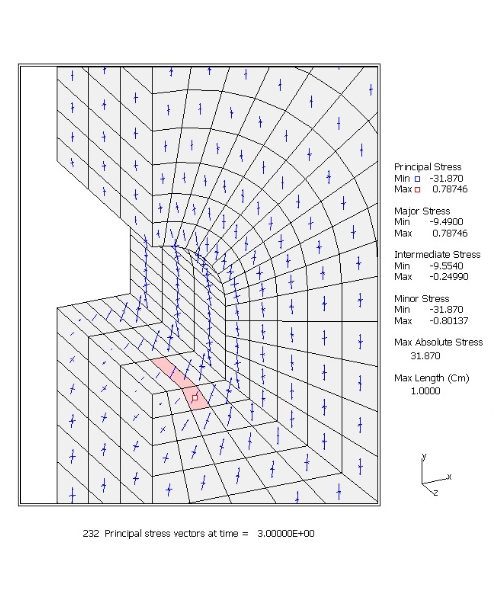
Principal stress distributions
Deformed shapes/displacement vectors
Truss axial force/stress/strain
Beam section force/stress/strain
Contours of stresses/strains/motions
PLOT-XY is used for the following time history plots:
Stress/strain time histories
Displacement/velocity/acceleration time histories
PLOT-3D is used for the following 2-D and 3-D plots:
Mesh plots
Deformed shapes
Beam or truss section forces
Isosurface plot for 3-D solid element
Principal stress vectors for shell and continuum elements
Contours for stresses, strains and displacements for shell and continuum elements